




Floor Screed Estimation: Getting Thickness and Coverage Right Before the Pour
Reliable screed quantities begin with actual slab levels and a planned allowance for variation.
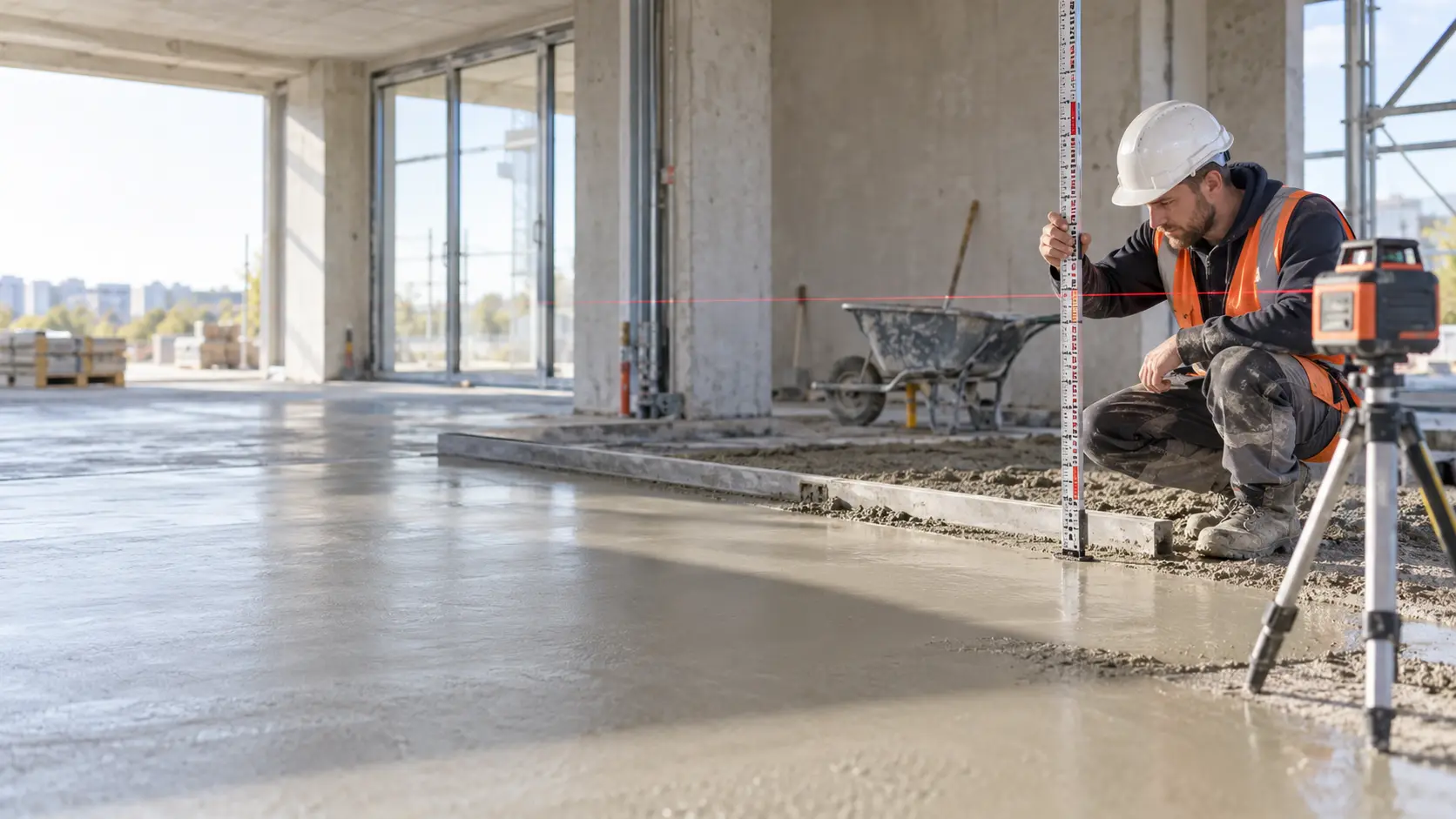
Screed is one of the few construction materials where the estimation error and the structural consequence are separated by weeks. Order the wrong quantity of tile adhesive and a crew waits a day for more bags. Underestimate screed and the shortfall often isn't visible until it's already been poured thin in places — showing up later as inadequate falls to drain, inconsistent finish levels, or a floor that won't take the specified floor covering without remedial leveling work.
Thickness is a range, not a number
Screed quantity depends on average thickness across the full floor area, and average thickness depends on what's underneath it — which is precisely the variable most estimates treat as fixed.
A structural slab is rarely perfectly flat. Deflection, formwork tolerances, and construction sequencing all leave a slab with high and low points across its surface. A screed poured to a nominal 40mm thickness on paper might realistically range from 25mm in high spots to 60mm or more in low ones, once it's leveled to a true, flat finished surface. Estimating from the nominal thickness alone — rather than the actual slab survey — is the single most common source of screed quantity shortfalls.
Falls to drain in wet areas, bathrooms, balconies, and terraces compound this further: thickness deliberately varies across the pour by design, and a flat average-thickness estimate will consistently undercount material for any floor with engineered slope.
What changes the numbers
Bonded vs. unbonded vs. floating screed. The application method affects both minimum thickness requirements and how forgiving the system is to slab irregularity. Bonded screeds can generally go thinner; unbonded and floating systems over a membrane or insulation layer typically require greater minimum thickness to maintain structural integrity and resist cracking.
Substrate survey data. A level survey — even a basic grid of spot measurements across the floor plate — turns estimated thickness into measured thickness and removes the single biggest source of estimation error. On larger commercial floor plates, this is worth the half-day it takes.
Screed type and yield. Cementitious, self-leveling, and fast-track screed products have different densities and different yields per bag or per batch. Self-leveling systems in particular are sensitive to exact water-to-powder ratios, which affect final coverage.
Curing and drying program. This doesn't change the material quantity, but it does change project sequencing risk. Underestimating drying time before floor covering installation is a related, equally common estimation failure that shows up as adhesion problems in the finished floor.
Using a calculator without letting it hide the assumptions
Bondure's Floor Screed Calculator is built to take average thickness, area, and product yield as direct inputs — which means the accuracy of the output depends entirely on the accuracy of the thickness figure entered. That's a feature, not a limitation: it puts the judgment call where it belongs, with whoever has surveyed the slab, rather than burying it inside a black-box formula.
For any floor plate larger than a small residential room, or any area with engineered falls, the recommended sequence is:
1. Survey actual slab levels. Take measurements at a reasonable grid spacing.
2. Establish the required finished floor level. Calculate true average thickness from the difference.
3. Add a contingency for low-spot buildup. Typically allow 10–15% beyond the calculated average.
4. Confirm screed type and yield. Check the specific product's technical data sheet, not a generic assumption.
The takeaway for specifiers
A screed quantity estimate is only as good as the slab data behind it. Treat the finished-level survey as a required input rather than an optional refinement, build contingency into low spots deliberately rather than as an afterthought, and the number that lands on the delivery note will match the number the floor actually needs.